The Los Angeles County Criminal Court System
Facing criminal allegations in Los Angeles County places an individual inside one of the largest and most complex unified trial court systems in the United States. With dozens of specialized branch courthouses spanning from the Clara Shortridge Foltz Criminal Justice Center (CCB) in Downtown Los Angeles to the Van Nuys, Airport (LAX), and Governor George Deukmejian Courthouse in Long Beach, understanding the procedural milestones of your case is vital to securing a favorable defense outcome.
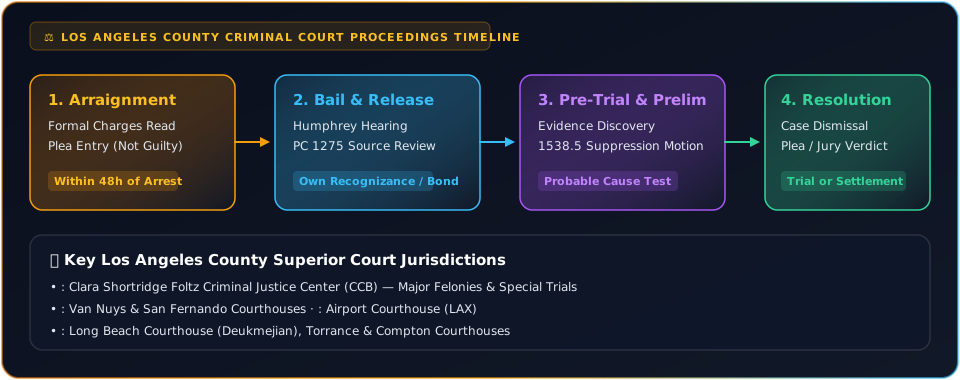
1. The Arrest & Initial Arraignment Stage
Following an arrest by the Los Angeles Police Department (LAPD), Los Angeles County Sheriff's Department (LASD), or California Highway Patrol (CHP), California Penal Code § 825 mandates that an in-custody defendant must be brought before a magistrate for formal Arraignment within 48 hours (excluding weekends and statutory holidays).
At arraignment, the presiding judge informs the accused of the specific complaint filed by the District Attorney or City Attorney. The defense attorney enters an initial plea of Not Guilty, receives the initial discovery packet (police incident reports, body-worn camera footage logs), and addresses custody status.
2. Bail Determinations & Humphrey Hearings
Under the landmark California Supreme Court ruling in In re Humphrey (2021), trial courts are constitutionally prohibited from conditioning pre-trial release solely on unaffordable cash bail without establishing that non-monetary conditions cannot reasonably protect public safety.
- Own Recognizance (OR) Release: The defense petitions for release without monetary bail, supported by verified community ties, employment history, and clean appearance records.
- PC 1275 Holds: If the prosecution alleges bail funds derive from felonious conduct, the defense must file a Penal Code § 1275 motion proving the legitimate source of premium payments.
3. Pre-Trial Motions & Evidence Discovery
Between arraignment and trial, aggressive pre-trial litigation often determines the outcome of the case:
| Pre-Trial Motion | Statutory Authority | Defense Objective |
|---|---|---|
| Motion to Suppress Evidence | California Penal Code § 1538.5 | Exclude physical evidence obtained through unlawful Fourth Amendment stops or warrantless searches. |
| Pitchess Motion | Evidence Code §§ 1043–1046 | Expose confidential officer personnel files demonstrating prior patterns of fabrication, excessive force, or perjury. |
| Serna Motion (Speedy Trial) | Sixth Amendment / PC § 1382 | Dismiss charges when prosecutorial delay prejudices defense evidence or witness availability. |
| 995 Motion to Dismiss | California Penal Code § 995 | Dismiss felony information following preliminary hearing if magistrate lacked sufficient probable cause. |
4. Preliminary Hearings for Felony Matters
In felony prosecutions, the defendant is entitled to a Preliminary Hearing within 10 court days of arraignment (unless time is waived). During this evidentiary hearing, the prosecutor must present witness testimony and evidence establishing probable cause that a felony occurred and the defendant committed it.
A seasoned criminal defense attorney uses the preliminary hearing to cross-examine arresting officers under oath, lock in witness testimony, expose inconsistencies, and petition the magistrate to reduce "wobbler" felony offenses to misdemeanors pursuant to Penal Code § 17(b).
5. Trial or Negotiated Resolution
If pre-trial motions and preliminary evaluations do not lead to an outright dismissal, the case proceeds to trial readiness. In Los Angeles Superior Court, cases are resolved through:
- Diversion Programs: Primary Caregiver Diversion (PC 1001.36), Mental Health Diversion, or Military Diversion that result in full dismissal and record sealing upon completion.
- Favorable Plea Bargains: Charge reductions that eliminate mandatory state prison terms or immigration consequences.
- Jury Trial: Rigorous defense before a 12-person jury requiring a unanimous verdict of proof beyond a reasonable doubt.