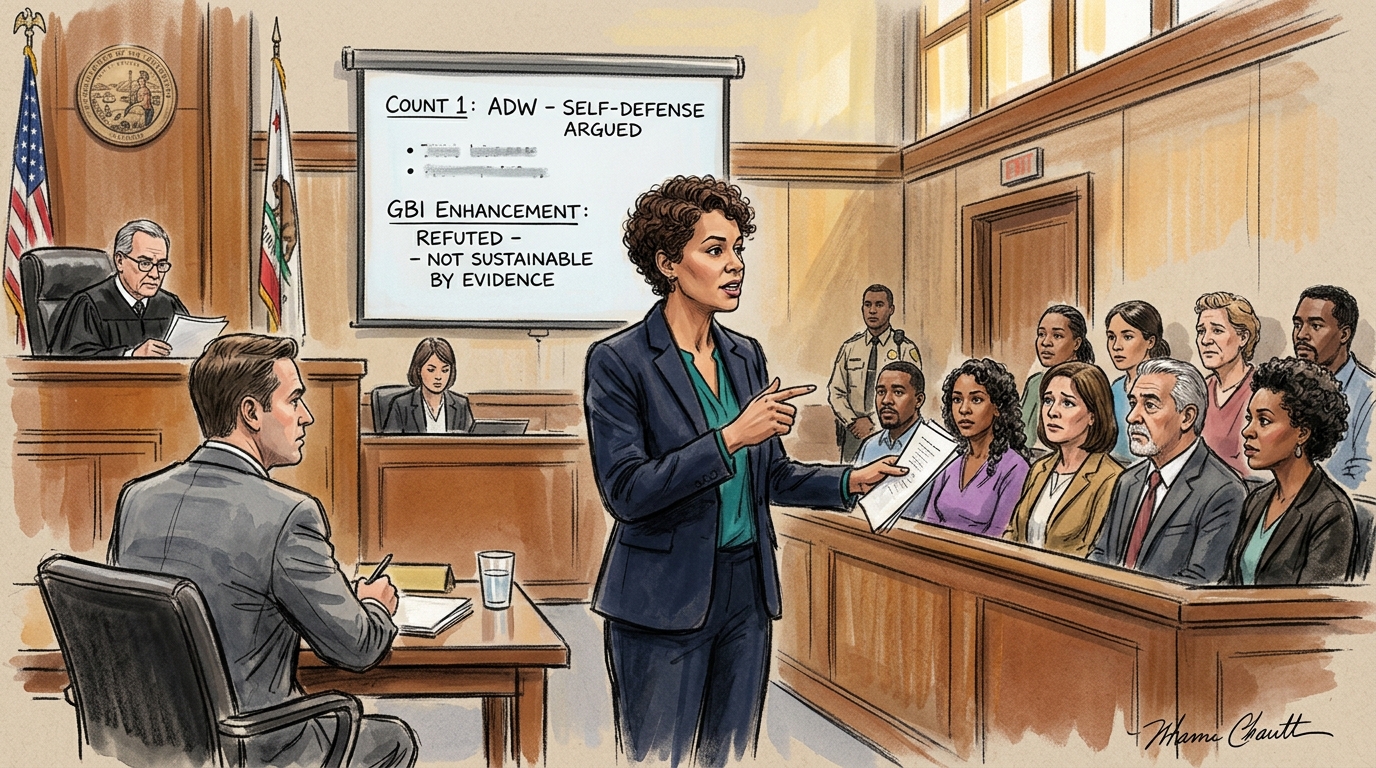
Under California Penal Code Section 245(a)(1), Assault with a Deadly Weapon (ADW) is among the most serious violent crime allegations prosecuted in Los Angeles County. Because ADW is a "wobbler" offense that carries potential California Three Strikes consequences and severe sentencing enhancements, establishing robust self-defense evidence under CALCRIM jury instructions is vital to securing dismissals and acquittals.
Statutory Elements of Penal Code Section 245(a)(1)
To convict a defendant of ADW under PC 245(a)(1), the prosecution must prove three statutory elements beyond a reasonable doubt:
- The defendant did an act with a deadly weapon other than a firearm that by its nature would directly and probably result in the application of force to a person;
- The defendant did that act willfully; and
- When the defendant acted, they had the present ability to apply force with a deadly weapon to a person.
Under California law, a "deadly weapon" is defined broadly as any object, instrument, or weapon that is inherently deadly (such as a knife or dagger) or used in a manner capable of causing death or great bodily injury (including motor vehicles, baseball bats, broken glass, or heavy tools).
Sentencing Penalties & Enhancements
- Misdemeanor ADW: Punishable by up to one year in county jail, maximum $10,000 fine, and formal probation.
- Felony ADW: Punishable by 2, 3, or 4 years in California state prison. If the offense is charged as a felony, it constitutes a serious felony and a "strike" under California's Three Strikes Law.
- Great Bodily Injury (GBI) Enhancement (PC 12022.7): If the assault results in significant physical injury, prosecutors attach a mandatory consecutive 3-year prison enhancement, rendering the conviction a violent felony subject to 85% custody time.
California Stand Your Ground & Self-Defense Invariants (CALCRIM 3470)
California does not require a person to retreat before using force to protect themselves. Under California Criminal Jury Instruction CALCRIM 3470:
CALCRIM 3470: Complete Defense of Self and Others
A defendant is not guilty of assault if they reasonably believed they or someone else was in imminent danger of suffering bodily injury or unlawful touching, reasonably believed that immediate force was necessary to defend against that danger, and used no more force than was reasonably necessary.
No Duty to Retreat: A person who is attacked has the right to stand their ground and defend themselves, and if reasonably necessary, to pursue the attacker until the danger of death or bodily injury has passed.
Strategic Defense Approaches in ADW Litigation
- Lack of Present Ability: Demonstrating that the physical distance or structural barrier made the actual application of force impossible at the moment of the alleged act.
- Absence of Deadly Weapon Intent: Refuting the claim that an everyday utilitarian item was used in a manner calculated to produce great bodily injury.
- Mutual Combat & Defense of Property: Establishing that the complaining witness was the initial aggressor who escalated the encounter.
- Pretrial Romero Motions: Filing motions under People v. Superior Court (Romero) to strike prior strikes in the interest of justice.